Family Business
Towards the end of the seventies, Asplan Beldam moved his home from Stratford in East London—where he is reputed to have made his first packings on the kitchen table with the help of Mrs. Beldam—to Acton, then a pleasant rural suburb. He took the manufacture of the packings into the district with him, and very soon after acquiring the Boston Lodge estate in Brentford, he set up the packings operation in a few small buildings at the southern end of the site. That is where the Beldam Packing and Rubber Company, vastly expanded of course, still flourishes.
Meanwhile, Asplan had brought one of his brothers, Robert, into the business as Sales Manager. Both men were strong personalities with decided views on most matters, so conflict about the conduct of the business was probably inevitable. At all events, Robert left the firm in 1891 to set up first as a general merchant in the City, and later to form a packings company of his own.
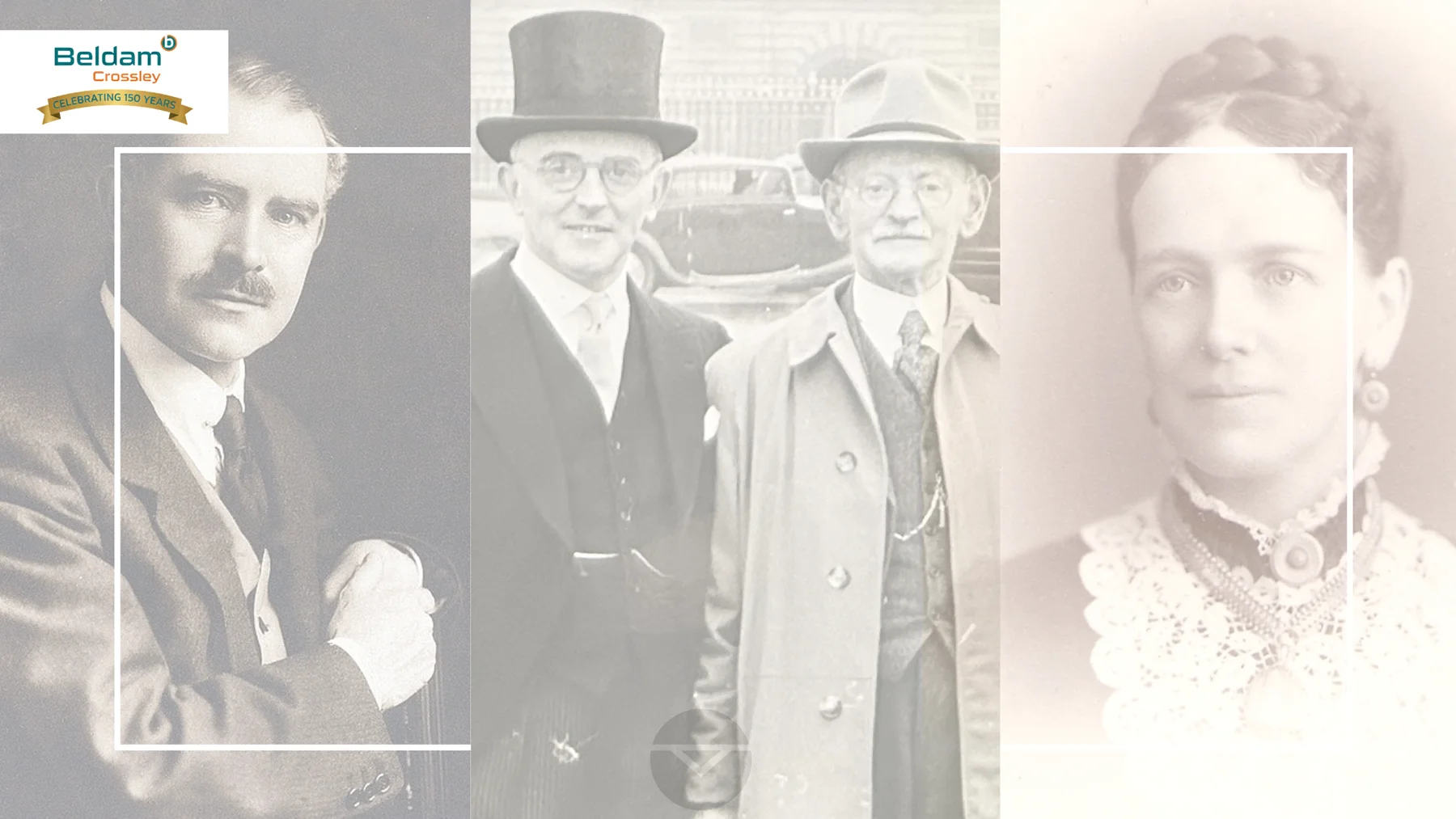
Asplan had brought his two sons, George William and Cyril Asplan, into the business. They were both Cambridge graduates with engineering training, and both remarkable men in different ways. George was keenly interested in technical matters—a prolific inventor who, in later years, amassed an impressive array of patents on an astonishing variety of articles, from manhole covers through golf clubs and photographic plates to tyres and tobacco pipes—not to mention dozens of patents for packings and jointings.
Cyril early displayed a talent for financial administration and office organisation. These divergent capabilities more or less decided the roles the brothers would play in the Beldam Packing enterprise—Cyril organising the financial control, sales and distribution from the City office, and George running the factory. But that is leaping ahead of our story.
All the time, pressures and temperatures used in marine steam engines continued to rise. Asplan and George—and to a lesser extent Cyril—were constantly devising and trying out new forms of packings to keep Beldam products ahead of increasingly severe operating requirements. Thus, in 1894, Asplan introduced his Tubular Packing, which embodied a number of small grease-filled tubes to assist lubrication. All the White Star Line ships were fitted with these for some years.
In 1904, the father-and-son team produced the original Pilot Packing, which had a solid rubber backing and a slotted white-metal bar embedded in the folded fabric. This bar provided a strong, low-friction, long-wearing bearing surface, while the slots in it enabled it to accommodate itself to a wide range of diameters. Pilot was a great success, and extensions to the Brentford plant were needed to cope with the demand. The name “Pilot” eventually became part of the company’s trademark, and the Brentford works were officially dubbed Pilot Works.
In the first decade of this century, Asplan, George, and Cyril produced and patented innovations and inventions by the score. Many were in the field of packings, but many more concerned products that could possibly become suitable subjects for the rubber manufacturing side of the business—pneumatic tyres, golf clubs, balls, cricket bat handles, the latter reflecting the fact that both George and Cyril were keen cricketers and good all-round sportsmen. There was even an application for a patent on stocking suspenders in the name of L. Beldam—which we believe was Leonie, Asplan’s wife—but the application was not proceeded with, so we are tantalisingly deprived of details of this possible testimony to the inventiveness of the distaff side of the Beldam family.
Like most other makers of packings, the Beldams had known for years that rubber, suitably vulcanised, offered great advantages as an impregnating medium for the fabric in packings. They already used it in packings for hydraulic and other low-temperature applications, where its qualities of flexibility and durability were plainly demonstrated. However, there was no rubber compound available that would stand up to the temperatures encountered in steam engines. It had been possible to use rubber in the Pilot in the form of a solid backing—which was a half-way step to the flexibility of a rubber-impregnated packing—but the compounds of 70 years ago disintegrated rapidly when used as thin impregnating films in the presence of high-temperature steam.
In the meantime the Crossley’s were also making headway…
(THE ENTIRE RELECTIONS SERIES CAN BE FOUND AT WWW.BELDAMCROSSLEY.CO.UK/ ABOUT-US/OUR-HISTORY)